
Hello People,
Welcome to the Second Post, “Into the Abyss”.
Let’s me start with something most of us are aware of…
The Varaha Avatar…
Varaha (Sanskrit: वराह, Varāha, “boar”) is the avatar of the Lord Vishnu who takes the form of a boar to rescue goddess Earth.
Varaha is listed as third in the Dasavatara, the ten principal avatars of Lord Vishnu.
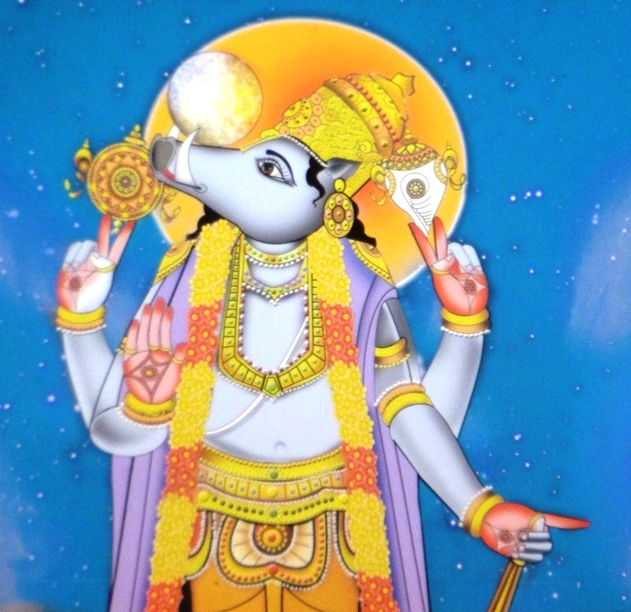
Now… that maybe a fantastic story all that..but when you look at the Ancient Scriptures,Statues and Paintings…
you’ll notice something fascinating and hiding in the plain sight all this time.
And that is,
In most of the art works the Earth is depicted as a
sphere…round…which indicates that pepole knew that the EARTH was spherical…

Which Europe only accepted once they saw the pictures from space sent by Apollo..
Infact, The Sanskrit word for Geography is Bhugolasastra.
See..Bhu means Earth , Sastra means Science and Gola means Round/Spherical.
Bhugolasastra = The Science of Spherical Earth
And we also call Earth as ‘Jagat’ meaning ‘Jiska Gati ho’…meaning which isn’t stationary…means they knew that the Earth wasn’t stationary
Meaning they knew that the Earth was revolving around the Sun.

And now Let’s go from Earth to Sun…
Like literally…
I guess most of you have seen it as a forwarded Social Media Message… But, It is worth Mentioning…
Let us decipher the calculation in Hanuman Chalisa…
Hanuman, in his childhood, assuming the Sun to be a ripe mango, jumped to catch it.
Tulasidasa recounts this incident in his Hanuman Chalisa as follows:
जुग सहस्र जोजन पर भानू ।लील्यो ताहि मधुर फल जानू ॥
Hanuman Chalisa
“Considering the Sun to be a sweet fruit, Hanuman jumped to swallow it.”
Here the distance he travelled is mentioned as yuga-sahasra-yojana. Let us try to decipher this.
What is a yuga? According to Bhagavad-gita, one day of Brahma is called kalpa and is equal to 1000 yugas and this is followed by a similar duration of night.
1 yuga = 4,320,000 years = 12000 divine years
(1 divine year = 360 years according to human calculation)
This is also confirmed in Manu-samhita: etad dvaadasha sahasram devanam yugamuchyate
According to the above verse from Hanuman Chalisa, the distance between Sun and Earth is
yuga-sahasra-yojana = 12000 x 1000 yojanas.
Yojana is a Vedic measure of distance and approximately equals to 8 miles (according to the 14th century scholar Parameshvara, the originator of drgganita system).
And 1 mile = 1.60934 kilometers.
According to the calculation presented in Hanuman Chalisa
Distance between Sun and Earth = 12000 x 1000 yojanas = 96 million miles = 153.6 million kms.
And it is approximately 150 million kms accroding to Modern Science…
Which is approxiamtely equal to the calculation.
The assumptions we have made in the above calculations are as follows:
We assumed yuga to mean the number 12000 based on the time calculation system of Vedic period based on the statement from Bhagavad-gita and Manu Samhita.
We approximated 1 yojana = 8 miles based on what Srila Prabhupada has mentioned in his purports. However there is still disagreement among scholars as to whether it is 5 miles or 8 miles. Some other calculations indicate values ranging from 7.6 miles to 8.5 miles.

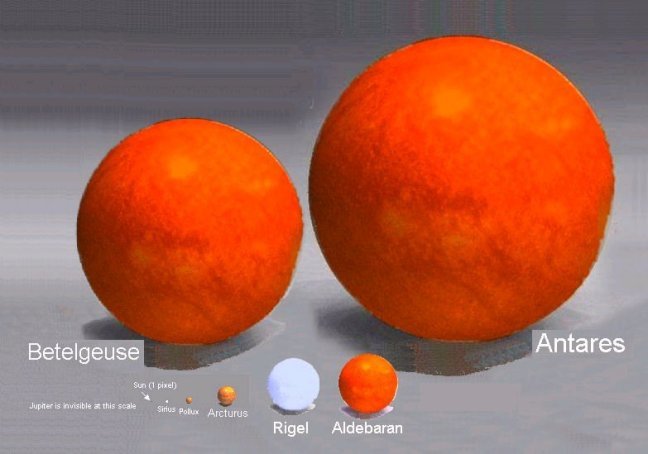
Now, there is this star called “Antares” ..Ares means Mars which is Red… and this star is also red. Hence, Antares meaning like Mars.
This ” Antares ” is the 15/16 TH brightest object in the sky. Yet, our elders, our ancients called it ‘Jhestha’.
So, What does ‘Jhestha’ mean.
Jhestha means the biggest,the oldest, the eldest.
The question arises again…Why would they call the 15th brighest object, the biggest?
Intutively the brighter should be bigger.
But they called the 15 th brightest the biggest.
Turns out, they were right.
It is 40,000 times bigger than our sun. In fact, it is one of the biggest objects known to man.
Now just imagine you’ve got this group of people who managed to name a point in the sky the biggest and this was 5-7000 years ago.
The Jantar Mantar in Jaipur is actually one of six major observatories built by the Maharajah.
The one in Jaipur not only follows the movements of the sun and the moon to help determine auspicious dates for events, it also helps map out the position of the stars in the sky.
Although no telescopic instruments were available at the time, the precise observation of the stars was greatly facilitated by observatories such as Jantar Mantar.
It should also be noted that such an endeavor (six major observatories, a staff of full-time priests etc.) did not come to a small cost.
This is further evidence of the importance placed on the study of the stars.
As mentioned earlier, both astrology and astronomy were reasons to build these structures.
Unlike the “west”, astrology did not become as pseudo-science as astronomy became more factual and experimental.
Instead, both were considered an integral part of society.

Aryabhata wrote that 1,582,237,500 rotations of the Earth equal 57,753,336 lunar orbits.
This is an extremely accurate ratio of a fundamental astronomical ratio (1,582,237,500/57,753,336 = 27.3964693572), and is perhaps the oldest astronomical constant calculated to such accuracy.
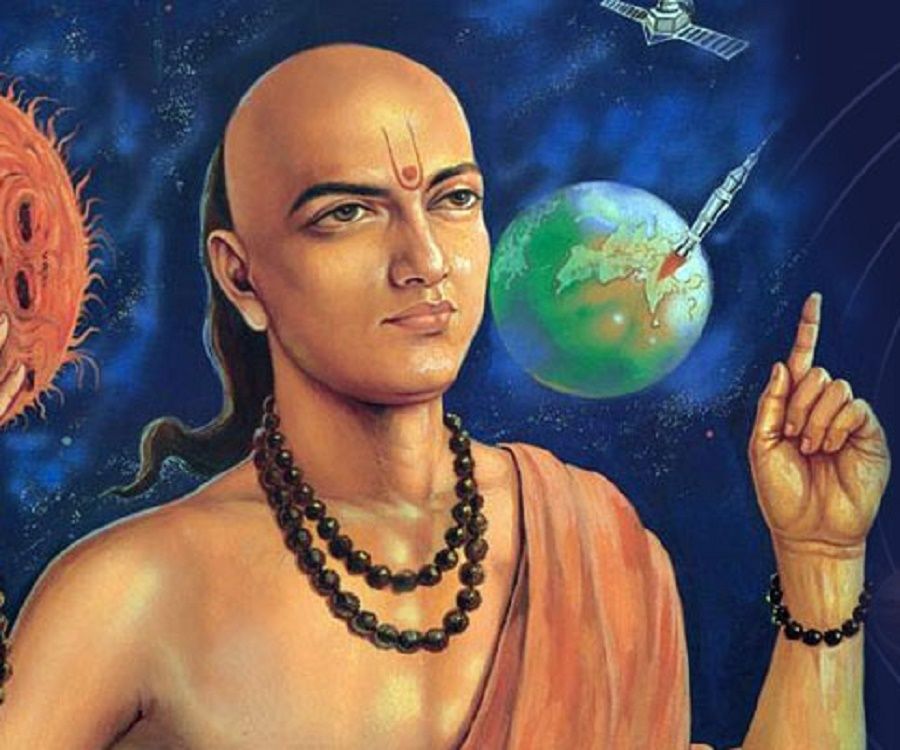
Aryabhatta’s Magnum Opus, the Aryabhattiya was translated into Latin in the 13th century.
Through this translation, European mathematicians got to know methods for calculating the areas of triangles, volumes of spheres as well as square and cube root.
Aryabhatta’s ideas about eclipses and the sun being the source of moonlight may not have caused much of an impression on European astronomers as by then they had come to know of these facts through the observations of Copernicus and Galileo.
But considering that Aryabhatta discovered these facts 1,500 years ago, and 1,000 years before Copernicus and Galileo makes him a pioneer in this area too.
Aryabhatta’s methods of astronomical calculations expounded in his Aryabhatta-Siddhatha were reliable for practical purposes of fixing the Panchanga (Hindu calendar). Thus in ancient India, eclipses were also forecast and their true nature was perceived at least by the astronomers.

Brahmagupta (598-668) was the head of the astronomical observatory at Ujjain and during his tenure there wrote a text on astronomy, the Brahmasphutasiddhanta in 628.
He was the earliest to use algebra to solve astronomical problems.
He also developed methods for calculations of the motions and places of various planets, their rising and setting, conjunctions, and the calculation of eclipses of the Sun and the Moon.
Bhaskara (1114-1185) was the head of the astronomical observatory at Ujjain, continuing the mathematical tradition of Brahmagupta.
He wrote the Siddhantasiromani which consists of two parts: Goladhyaya (sphere) and Grahaganita (mathematics of the planets).
He also calculated the time taken for the Earth to orbit the sun to 9 decimal places.
Heard about the Great Bear Constillation?

We’re interested in that star…
Our elders named it Arundhati….seems familiar right.
Yes…In South India, there is a tradition/ part of the marriage ceremony during which the Husband and Wife are supposed to go out and look at this particular star.
Again the Magic word.. Why?

It turns out…This particular point in the sky is not actually one star but Two Stars..It is called Arundhati-Vasistha.
Two stars being together is called a Twin Star System.
Oh..we’re not done yet.
Most of the twin star systems rotate like this…

One star is in the centre and the other star goees around it…
But, Arundhati-Vasistha, this particular system moves like this…

And isn’t this how a Couple should be?
First, to figure out that is a twin star system.
Second, to figure out that this rotates in a way different than others..
This is not something which is easy or obvious.
This is Awesome.
Now, Let’s come back to Earth as this post ends now..
And thanks for reading through…
Please Share.
Thank You.

 DECODING HINDUISM